Showing posts with label automobile syatem. Show all posts

Thursday, June 27, 2013

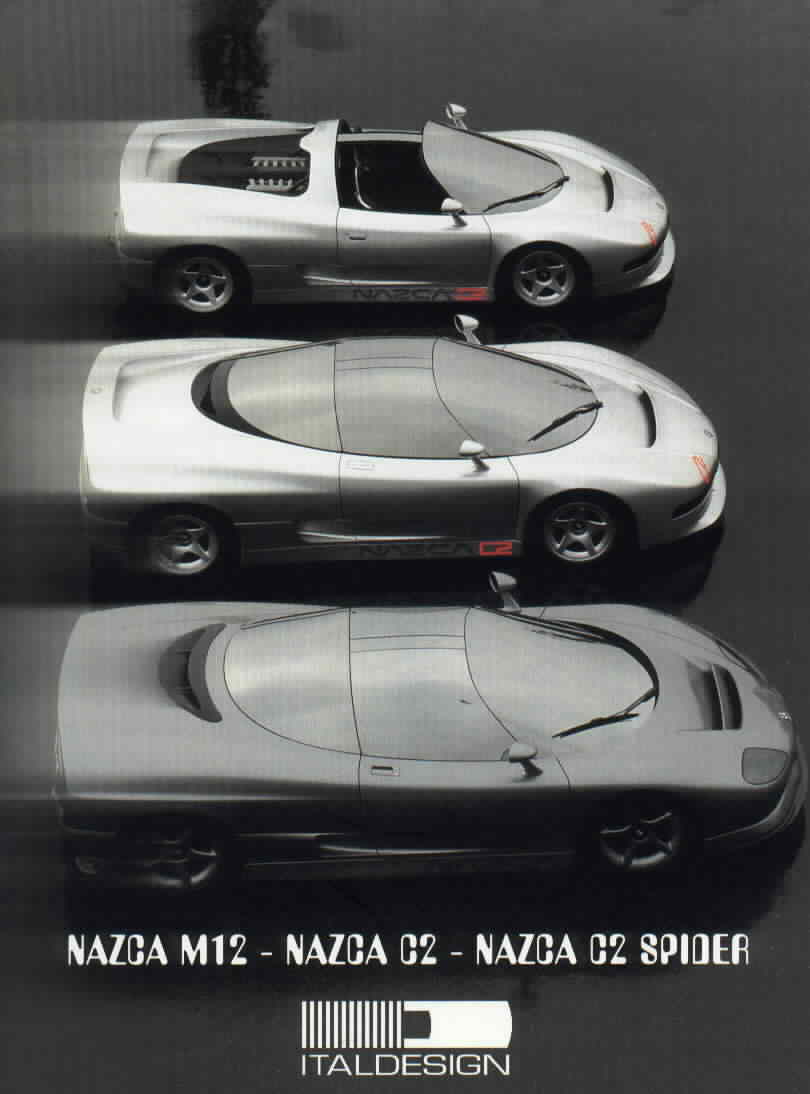
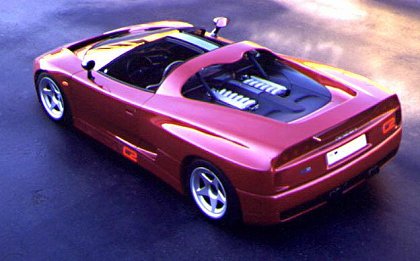
BMW Nazca C2

The BMW Nazca C2 (also known as Italdesign Nazca C2) was a 1991 conceptsports car. The car was designed by famed automotive engineering companyItaldesign, home of Giorgetto Giugiaro, and features a similar frontal design of aBMW. The car was equipped with the Neuromotion FC6 engine from BMW and produced 680 bhp (507 kW; 689 PS). The car had a top speed of 227 mph (365 km/h). Three cars in total were produced.

Mazda: Revamped 2014 Mazda 3 to lead compact segment in mpg

Mazda's next-generation Mazda3, equipped with its full set of technologies developed to reduce weight and enhance fuel efficiency, will top thecompact car segment in mpg when it goes on sale in the United States this fall, the automaker said today.

This fantastic car is made by mazda which launch in 2014 in united state.that very fast car and very buitiful.
have a latast light which create large beem of light in your benifit.
Every thing in this cr is very intrusting because of that this face is very enjoy full.

I waiting for your comment and like.

Wednesday, June 26, 2013

Hydrogen & Fuel Cell Conference in Vancouver.

Toyyota arrange Hydrogen & Fuel Cell confrance in canada. in this conferance the people come from 50 contries and watch fuel eficeant car which run on Hydrogen & Fuel Cell. 
This Year’s Theme: Power, Transportation and Energy Storage: An Industry on the Move
A Leading International conference with an expected 1,000+ delegates from more than 50 countries, including Canada, Germany, US, Japan, Korea, China
We look forward to hosting you in 2013!

hybrid Racing car.

Toyota introduce TS030 Hybrid for street racing. this car is run on bettry which charged by our home electercity.
toyota try to run in racing now in 2013 toyota is sucsessful in this mission  now this car is run very fast and on electtercity. this test pre pration held in canada we can see this in blow pictures.

The Camatte 57s


The concept of toyota cars this is made by origional camette that's why this car name is The Camatte 57s .
toyota unviled to new do-it-self concept of this car. three people acmmotate in tisc biutiful car.Very stylish and good looking car concept.What do you think of this fun kit style 3 seater?

toyota fortuner the junmbo car.

The Toyota Fortuner, also known as the Toyota SW4, is a medium-sized SUV based on the Toyota Hilux. Originally assembled only in Thailand, but later also in Indonesia and other countries, the Fortuner is built on the Toyota Hilux pickup truck platform. It features three rows of seats and is available in rear-wheel drive or four-wheel drive among others. The Fortuner is part of Toyota's IMV project in Thailand, which also includes the Toyota Hilux and the Kijang Innova (in Indonesia). The Fortuner, meanwhile, arrived Thailand in 2004 and raised the low-cost SUV game significantly with a much more integrated SUV design language compared to the preceding 4Runner, which always retained a look of the ‘backyard conversion’ about it. Developed in large part by Toyota’s Thai operations, the Fortuner has piggybacked the success of the Hilux and is now built in a number of countries including India, Argentina and Indonesia, although outside Thailand its success has been mixed. However in the Sydney Morning Herald, Gillard who worked for the Toyota Technical Centre (TTC-AU) stated that the organization has been working on the Fortuner since 2006. In fact, this Sport Utility Vehicle (SUV) is designed in Thailand by Thai and Japanese engineers However the facelift version of the IMVs vehicles including the Fortuner was designed in Australia by TOYOTA Australia who, in addition, are responsible for developing the next generation of the Fortuner.

Friday, March 16, 2012

Excise, customs duties on large, foreign-made vehicledes hik

Sedan and foreign-made luxury cars will cost more from April 1, 2012 as Finance Minister Pranab Mukherjee Friday proposed to raise excise and customs duties on large cars as well as imported luxury vehicles.

"I propose to enhance the duty from 22 percent to 24 percent (large cars)," Mukherjee said, presenting the union budget 2012-13 in the Lok Sabha.

The increase in excise duty will affect the price of petrol-powered vehicles with engine capacity of under 1,200 cc and diesel cars with engine capacity under 1,500 cc whose length exceeds four metres.

"In the case of cars that attract a mixed rate of duty of 22 percent plus Rs.15,000 per vehicle, I propose to increase the duty and switch over to an ad valorem (according to value) rate of 27 percent."

Currently, large cars attract excise duty depending on their engine capacity and length.

For import of completely built units (CBU) of large cars, multi and sports utility vehicles with cost exceeding $40,000 (Rs.2,000,000), per car custom duty will increase to 75 percent from 60 percent.

Mukherjee, however, provided excise duty relief for electric and hybrid vehicle manufacturers.

Excise duty on replacement batteries for supply to electric vehicle manufacturers registered with IREDA (Indian renewable energy development agency) or state nodal agency which is notified for the purpose by the new and renewable energy ministry for central finance assistance has been proposed to reduce from 10 percent to six percent.

The excise duty on specified parts of hybrid vehicle has also been reduced from 10 percent to six percent.

Reacting to the proposed excise hike, automobile major Tata Motors said it has decided to increase prices of its commercial and passenger vehicles with immediate effect.

The company said the increase will be proportional to the increase in the excise duty proposed in the budget.

Other auto companies like Maruti Suzuki are said to be also contemplating a price hike.

Meanwhile, Lowell Paddock, president and managing director of General Motors India, expressed disappointment for the sector.

"As far as the automotive industry is concerned, it did not meet the expectations. The industry did not expect any increase in excise duty on passenger cars," Paddock said.

"The industry expected the government to announce some measures to fuel demand of vehicles which have also not happened."

Sunday, August 7, 2011

Trends: Air Powered Cars


Mini air car
As odd as it sounds, running a car on air is a reality. Proof of concept and prototype compressed air vehicles - commonly referred to as "air cars" - have been running around for a number of years.
How could it be possible to run on air? Consider the physical work that compressed air already does to make our everyday lives easier. Mechanics rely on air-driven pneumatic tools every day to turn nuts and bolts with authority in garages around the world. Pneumatic tools are powerful, even at a relatively low pounds per-square-inch (psi) pressure setting. They can free rusted-on lug nuts and separate metal from metal through an air hammer or pneumatic chisel. Crank the pressure up and compressed air is a force to be reckoned with, providing enough power to even propel a wheel driven car.
Guy Negre And Air Engine
Perhaps that was the inspiration that led former Renault F1 mechanic Guy Negre of Motor Development International (MDI) to pursue compressed air propulsion for the auto industry. And what could be more environmentally friendly than a car with atmospheric air as its only exhaust emission? There's no combustion whatsoever. Power comes from compressed air sourced from special high-pressure compressors run by electricity from the grid.
MDI's design uses a pair of air driven pistons, one large and one small, to turn a crankshaft that produces a rotational force. The technology can potentially be paired in two, four, or six cylinder engine configurations and the design is quite inventive. Since there is no combustion and the only engine heat comes from friction, the engine can be made primarily from lightweight aluminum.
Compressed Air Engine Illustration
For those who want the technical details, here's the scoop: In MDI's air engine, the small piston has a conventional connecting rod for turning the crankshaft, while its neighboring larger piston utilizes an innovative rocker arm configuration with the connecting rod. This design allows the large piston to pause at top-dead-center for 70 degrees of crankshaft rotation while metered air pressure builds in a prechamber as the small piston keeps the crank turning during its power stroke. The large piston then turns the crankshaft with greater power as the pair combine to produce power over 270 degrees of crankshaft rotation. Got that all?
Prototype air cars are minimalist transportation that typically exhibit a top speed of about 70 mph and a range of approximately 125 miles on flat roads before requiring a refill. Compressed air is stored at 300 bar (4351 psi) in carbon fiber tanks mounted longitudinally beneath the vehicle floor. Refilling can be accomplished in a matter of minutes at a special high-pressure pump or in about four hours via a home refueling appliance or even an on-board compressor.
2007 Tata Nano
In 2007, Tata Motors licensed the rights from MDI for $28 million to build and sell Tata-branded air cars in India. Tata has not confirmed if it will build one of the MDI prototype cars or, more likely, install the MDI technology in one of its existing cars like the light weight Nano (shown here). The Nano is Tata's $2,500 "scooter replacement" people's car that recently made headlines. While sought after in developing countries, this inexpensive car clearly won't meet federal emissions and safety requirements in the U.S. and other regulated markets around the world. Still, the addition of air power to an already inexpensive and efficient model would be quite appealing in the Indian market and others where fundamental transportation is in demand, and air pollution could be a serious challenge as exponentially greater numbers of vehicles make their way to the highway.
In the United States, a company called Zero Pollution Motors (ZPM) has licensed the rights to produce the MDI design in a U.S. factory. Based in New Platz, New York, ZPM has an ambitious goal of rolling out a North American compressed air vehicle for $18,000 by 2010. The company most recently unveiled MDI's newest car at the Automotive X-Prize exhibit at the New York Auto Show. ZPM and MDI will field two entries - the U.S. production six seat, four door prototype in the mainstream class, and the three seat, two door economy-utility model in the alternative class.
Zero Pollution Motors air car concept
Air cars haven't escaped the attention of mainstream U.S. automakers, too. For example, Ford has worked with an engineering team at UCLA to develop an air hybrid. In this application, the air hybrid builds air pressure using the engine as a pump while shut down during deceleration, and then utilizes the recaptured energy to launch the vehicle from a stop. Special electrohydraulic actuators in the valvetrain make the transition possible.
Air powered cars are not a new idea, and in fact the concept actually predates a viable internal combustion engine. In his book, "Paris in the 21st Century," Jules Verne foresaw a transportation system utilizing compressed air. Now, modern visionaries are striving to make that dream come true with the air car.

Active Fuel Management


Active Fuel Management (formerly known as Displacement on Demand) is a trademarked name for the automobile variable displacement technology from General Motors. It allows a V6 or V8 engine to "turn off" half of the cylinders under light-load conditions to improve fuel economy. Estimated performance on EPA tests show a 5.5%-7.5% improvement in fuel economy.
GM's current Active Fuel Management technology uses a solenoid to deactivate the lifters on selected cylinders of a pushrod V-layout engine.

BACKGROUND
                             High-powered multi-cylinder internal combustion engines may be necessary to satisfy driver demands for quick acceleration and/or heavy towing capacity, but during daily use they are generally operated at power settings of less than 25%. For example, at freeway speeds, less than 40 hp (30 kW) are required to overcome aerodynamic drag, rolling friction, and to operate accessories such as air conditioning.
However, when a gasoline internal combustion engine is operating under less than full load, the effective compression ratio is much less than the measured compression ratio. Under light load, the throttle is not fully open, and the cylinders receive less than a full charge of air on each intake stroke. The pressure and temperature generated at combustion are therefore less than under full load, and the thermodynamic laws which apply to all heat engines dictate that the engine will then be operating at less than its maximum possible thermal efficiency.
Thus, a high-powered, large-displacement engine is highly inefficient and wasteful when being used for normal driving conditions. This is the motivation for cylinder deactivation, to effectively spread the work load of the engine over fewer active cylinders which then operate under higher individual loads and therefore at higher efficiency.
Holden_AFM

SECOND GENERATION
                                              In 2004, the electronics side was improved greatly with the introductions of Electronic Throttle Control, electronically controlled transmissions, and transient engine and transmission controls. In addition, computing power was vastly increased. A solenoid control valve assembly integrated into the engine valley cover contains solenoid valves that provide a pressurized oil signal to specially designed hydraulic roller lifters provided by Eaton Corp. and Delphi. These lifters disable and re-enable exhaust and intake valve operation to deactivate and reactivate engine cylinders [1]. Unlike the first generation system, only half of the cylinders can be deactivated. It is notable that the second generation system uses engine oil to hydraulically modulate engine valve function. As a result, the system is dependent upon the quality of the oil in the engine. As anti-foaming agents in engine oil are depleted, air may become entrained or dissolve in the oil, delaying the timing of hydraulic control signals. Similarly engine oil viscosity and cleanliness is a factor. Use of the incorrect oil type, i.e. SAE 20W40 instead of SAE 5W20, or the failure to change engine oil at factory recommended intervals can also significantly impair system performance.
In 2001, GM showcased the 2002 Cadillac Cien concept car, which featured Northstar XV12 engine with Displacement on Demand. Later that year, GM debuted Opel Signum concept car in Frankfurt Auto Show, which uses the global XV8 engine with displacement on demand. In 2003, GM unveiled the Cadillac Sixteen concept car at the Detroit Opera House, which featured an XV16 concept engine that can switch between 4, 8, and 16 cylinders.
DUAL ACTIVE FUEL MANAGEMENT SEQUENCING - diagram, schematic, and image 03
On April 8, 2003, General Motors announced this technology (now called Active Fuel Management) to be commercially available on 2005 GMC Envoy XL, Envoy XUV and Chevrolet TrailBlazer EXT using optional Vortec 5300 V8 engine. GM also extended the technology on the new High Value LZ8 V6 engine in the Chevrolet Impala and Monte Carlo as well as the 5.3L V8 LH6 engine in the last generation Chevrolet Monte Carlo SS and Pontiac Grand Prix GXP. In both designs, half of the cylinders can be switched off under light loads.
On July 21, 2008, General Motors unveiled the production version of the 2010 Chevrolet Camaro. The Camaro SS with an automatic transmission features the GM L99 engine, a development of the LS3 with Active Fuel Management which allowed it to run on four cylinders during light load conditions.


Active Fuel Management | General Motors


Active Fuel Management™ is the proprietary technology for General Motors' variable displacement technology, The technology was designed and implemented to conserve fuel during driving situations that require low power demands. The process works by switching off half of the cylinders in the engine until higher demand performance (such as acceleration) reactivates the dormant cylinders. According to EPA test drives, the technology effectively improves fuel economy by 6 to 8 percent.
Active Fuel Management is typically reserved for larger [[GM] vehicles with V6 or V8 engines. In vehicles with V6 engines, the technology temporary turns the vehicle into an inline V3 engine. V8 engines are momentarily reduced to V4 performance. The technology made its debut in Cadillac's ill-received 1981 L62 V8-6-4 engine. Due to unpredictable functionality, the technology was panned until the 2005 model year, when advancements allowed for more reliable performance. Originally known as Displacement on Demand in concept cars such as the Cadillac Cien and Cadillac Sixteen, the technology was officially renamed Active Fuel Management prior to being made commercially available.
Active Fuel Management&##8482; image

Active Fuel Management - How it Works

The concept behind the technology of Active Fuel Management is that high-powered engines are excessively inefficient when high-demand power is not necessary. In fact, it is estimated that the average V6 or V8 engine only requires 25 percent of the engine's total power settings during the majority of everyday driving. Rather than install a smaller, more efficient engine and compromise acceleration and towing capacity, GM's Active Fuel Management system effectively deactivates unnecessary cylinders as needed to improve engine efficiency.
Generally speaking, the deactivation of cylinders begins by turning off the intake and exhaust valves. This is done through a solenoid control valve assembly that is signaled via pressurized oil to activate and deactivate hydraulic roller lifters. These lifters are the mechanism that physically close and open the exhaust and intake valves. Once both valves are closed, exhaust gas remaining in the cylinders expands in one cylinder as it decompresses in another. This compression adequately maintains power during low-demand situations. To initiate more power as needed, the exhaust valve is reopened to discharge the old exhaust gas and allow in a new cycle. On V8 engines, cylinders 1, 4, 6 and 7 are shut off during this process.

Due to the extreme precision necessary to create seamless operation of an Active Fuel Management engine, considerable electronic control is required. Advancements in vehicle system computing power, engine emission controls, electronic transmissions and GM's Electronic Throttle Control all contributed to the successful integration of Active Fuel Management technology in 21st-century vehicles.
GM Vehicles with Active Fuel Management
Presently, GM manufactures four different engines with Active Fuel Management technology. These four engines are the Vortec 5.3-liter V8, Vortec MAX 6.0-liter V8, 3.9-liter V6 and 5.3-liter small-block V8. Vehicles that are available with Active Fuel Management include the Chevrolet Avalanche, Chevrolet Impala, Chevrolet Silverado, Chevrolet Suburban,Chevrolet Tahoe and Chevrolet Trailblazer.

Competitor Equivalents to Active Fuel Management

Other automotive manufacturers offer similar variable displacement technologies. Mitsubishi was the first to offer an alternative to GM's technology, with the integration of Modulated Displacement (MD) technology in their 1982 1.4-liter 4G12 straight-4 engine. Like GM's first attempt in 1981, Mitsubishi's technology was discontinued shortly thereafter. The Japanese automaker improved and reintroduced the technology in 1993 under the moniker MIVEC-MD, only to be re-shelved in 1996. Mercedes-Benzintroduced Active Cylinder Control™ for their 12-cylinder engines in 2001, but discontinued the technology in 2002.
Currently, there are two variable displacement technologies that rival GM's Active Fuel Management system. Chrysler's Multi-Displacement System™ (MDS) was introduced in 2004 and is available in vehicles that feature a 5.7-liter HEMI V8 engine. Honda's Variable Cylinder Management™ (VCM) system uses i-VTEC technology to achieve similar results.

Acoustic Control Induction System


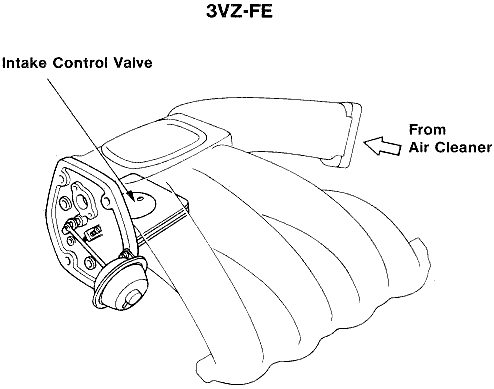
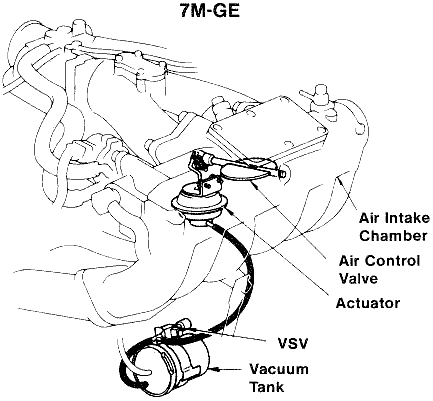
Acoustic Control Induction System, or ACIS, is an implementation of a Variable Length Intake Manifold system designed by Toyota.
Simply put, the ACIS system uses a single intake air control valve located in the intake to vary the length of the intake tract in order to optimize power and torque, as well as provide better fuel efficiency and reduce intake "roar"..
The engine control unit (ECU) controls the position of one or more air control valves based on input signals from throttle angle and engine RPM. The vacuum switching valve (VSV) which controls the vacuum supply to the actuator is normally closed and passes vacuum to the actuator when it is energized by the ECU. By energizing the VSV vacuum is passed to the actuator, closing the air control valve. This effectively lengthens the intake manifold run. By de-energizing the VSV, vacuum to the actuator is blocked and trapped vacuum is bled off of the actuator diaphragm. Toyota ACIS is an On/Off system. The valve (or valves in newer models with multiple valves to create more than 2 lengths) is either fully opened or fully closed. An example of early single-valve ACIS programming would be the 3.0L 3VZ-FE engine. The ECU actuates the VSV to close the valve when the throttle position is 60% or greater and engine speed is 3,900 RPM or greater.

Thursday, August 4, 2011

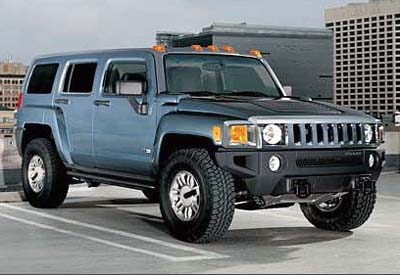
HUMMER H3

The Hummer H3 was a crossover SUV/Sport Utility Truck from General Motors' Hummer division introduced in 2005 based on the GMT355 underpinning the Chevrolet Colorado and GMC Canyon compact pickup trucks. Produced at GM's Shreveport, Louisiana factory and the Port Elizabeth plant in South Africa the H3 was the smallest among the Hummer models, and the first to be built by GM. It was available either as a traditional midsize SUV or as a midsize pickup known as the H3T.

Hummer H3